The Africa Guide - AfricaGuide.com
HOME | CONTACT US | LINK TO US | NEWS LETTER | AFFILIATES
TOURS & SAFARIS | GUIDE TO AFRICA | FORUMS | SHOP | ACCOMMODATION | PHOTO LIBRARY | CLASSIFIEDS
 
   
COUNTRIES SEARCH NEWS AFRICA MAP PHOTO LIBRARY OVERLANDING MEDICAL CHARITIES
 
Please visit our sponsor


Malawi

National Parks & Game Reserves

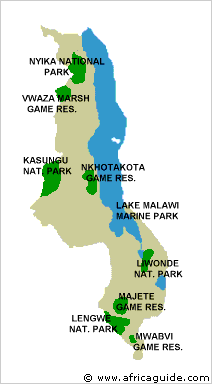
National Parks and Game Reserves Mwabvi Game Reserve Nyika National Park
Vwaza Marsh Game Reserve
Kasungu National Park
Nkhotakota Game Reserve
Lake Malawi Marine Park
Liwonde National Park
Majete Game Reserve
Lengwe National Park
Mwabvi Game Reserve


Malawi is a naturalists paradise, and boasts as rich a variety of large mammals as most African Countries; including the so called big five - buffalo, elephant, lion, leopard and rhinoceros. There are over 170 species of mammals and some 649 recorded species of bird.

As with everywhere, human population pressures have meant that most the big game species are now restricted to game reserves and national parks. Although these reserves are not as famous as some found in other East African countries, they offer comparable and excellent game viewing.

To get the most out of a game viewing expedition you will need to take into account the climate. The best times of the year for game viewing is during the dry season August to November. Some parks will be closed or impassable without a four wheel drive vehicle during the raining season, particularly Jan - March. To find out the latest situation at any of the parks enquire at the Wildlife Society Shop located in Blantyre or Limbe


NYIKA NATIONAL PARK  -  click to view recommended Tours and Safaris

Map

In 1965 The Nyika National Park became the first certified Park in Malawi. It encompasses the majority of the Nyika Plateau area in the Northern Region. It is the largest (covering an area of over 3,000 sq. km) and highest ( heights averaging 1,800m) of Malawi's parks bordering Zambia on the western side. The area is virtually uninhabited by man, with only a few settlements of Aphoka people. The Nyika is covered in moor-like, treeless grasslands, endless rolling hills, occasionally interrupted by pockets of evergreen forest in the ravines and valleys. There are numerous waterfalls on rivers flowing off the high plateau.

Owing to it's altitude, the Nyika offers a welcome break from the tropical heat of the lakeshore. Summer temperatures rarely exceed 21.5°C and in the winter months (June, July & August) an evening by the logfire provides a relaxing distraction. The area is passable most of the year round but is best visited in a 4x4 vehicle during the rainy season. November to May is the best time for game viewing, October to December for bird watching, whilst January and February are the best months to visit to experience the spectacular flowering of indigenous orchids.

The plateau is remote, wild and beautiful providing dramatic scenery and panoramic views, especially to the north. The Nyika National Park is home to large herds of zebra, eland, roan antelope, sable antelope, lichtenstein's hartebeest, kudu reedbuck, bushbuck, duiker, and warthog. It houses the largest concentration of leopard in the country. The nocturnal family of wild animals include hyena, jackal, civet cat, honey badger, porcupine and aardvark. Due to the absence of lion in the park, it is possible to go on a foot safari of up to 5 days but you must be escorted by a game scout.

More than 300 bird species have been recorded in the Nyika Plateau, including the Den Ham's bustard, the malachite sunbird and red winged francolin all found in the grassland area, whilst the cinnamon dove, bartailed trogon and starred robin are found high in the forest canopy, particularly the Chowo forest near the Zambian Resthouse. Four birds found on the Nyika plateau that have not been recorded anywhere else in Malawi, the yellow mountain warbler, churring cisticola, cracking cloud cisticola and mountain marsh widow. It also contains three butterfly species and one species each of chameleon , frog and toad which are found nowhere else.

The rivers and dams are stocked with rainbow trout, trout fishing being a very popular pastime here. Fishing permits must be arranged at head office at Chilinda and can be obtained all year round. for the Nyika Plateau area.

The gamepark entrance is situated 129km from Mzuzu and 68km from Rumphi. Drive west from Rumphi for approx. 60km and take a right turn towards the gate. There is a daily entrance fee payable at the gate.

Accommodation:
Approximately 56km from the entrance gate is Chilinda Camp where there a high luxury Lodge and a cheaper Camp with self catering units and a camp site.


VWAZA MARSH GAME RESERVE   -  click to view recommended Tours and Safaris

Click to view Map

Vwaza Marsh Game Reserve sees very few visitors , despite its easy access, inexpensive accommodation and rich diversity of animals and birds. It lies southwest of the Nyika Plateau, to the north of the floodplains of South Rukuru River and covers an area of 1,000 km². Road conditions are poor particularly in the raining season when a 4x4 vehicle is essential. The terrain is generally flat and the dominant vegetation type is mixed brachystegia and mopane woodland.

The populations of large animals vary from season to season as they cross the border from and to Zambia's Luangwa Game reserve. The reserve houses large herds of buffalo and elephants, and a great variety of antelope are present, including roan, greater kudu, Liechtenstein's hartebeest, eland and impala.

The birdlife include Goliath Herons, Openbill Storks, many birds of prey and the rare White-winged Starling. Lake Kazuni supports a good population of hippo and elephants can often be seen around the lake. Walking is permitted in this area (accompanied by a game scout).

A vast amount of wildlife can be seen around Kazuni camp and the lake, a truly spectacular sight.

A daily entrance fee is charged.

Accommodation:
Kazuni Safari Camp - This camp comprises four twin bedded rondavels made entirely of poles and grass with ensuite facilities and a main restaurant / bar under a secluded grove of Acacia trees.
Kazuni Camp - Self Catering - five grass huts with beds and mosquito nets and a central ablution block. Cooking places provided. All in a patch of evergreen trees.

Camping Right next to the self-catering camp (and using the same ablution block) is a campsite for those with their own tents.


KASUNGU NATIONAL PARK    Map

The Kasungu National Park is Malawi's second largest (over 2,000km2) lying at approximately 1,000m above sea level. It is situated in the Central Region approximately 165km north of the capital city, Lilongwe and 289km south of Mzuzu. To the western side the Park borders with Zambia. Kasungu provides some of the best available game viewing in the country, particularly at the end of the dry season from August to November, a time when waters levels begin to dwindle forcing the animals to stay close to the remaining watering holes in the park.

The Park is warm from the months of September to May and cooler from June to August. Most years the park is closed during March, maybe earlier if the rains are heavy. The roads are in better condition at the start of the dry season and has a network of untarred roads. Depending on what you do the best time to visit the park is:- August to January for Game Viewing November to December for bird watching June to September for walking August to September for the flora November to February for the orchids and wild flowers. The best months for photography for August to February.

The park's vegetation consists mainly of Miombo woodland broken up by grassy river channels, known locally as Dambos. A number of rivers flow through the park, the most important of which are the Dwanga and the Lingadzi, A tributary of the Lingadzi, the Lifupa, dams as Lifupa Lodge which creates the spot for game viewing within the park, especially to see the resident hippos. Kasungu is famed for it's population of elephants, though poaching is, even today, a big problem. A well as elephants it boasts a large variety of buck, including sable, roan, kudu, impala and Hartebeest as well as buffalo and zebra. Predators in the Park include, hyena, wild dog and serval. (I have even been lucky to see a leopard, but was many years ago).

Accommodation:
Lifupa Lodge is an upmarket, ideally located, approximately 14km from the main entrance gate and overlooking the dam. It is a 40 bed luxury lodge, includes four suites, all overlooking the dam. It also has a further 16 superior en suite rondavels. I don't have up to date prices but it is definitely not cheap. Adjacent to the Lodge there is a 24 bed self catering tented camp. There is a swimming pool at the lodge, facilities include an information centre and museum, shop, and petrol can be purchased. Activities provided by the lodge include open vehicle game drives, guided wilderness trails, sundowner cruises and visits to archaeological sites.


top

NKHOTAKOTA GAME RESERVE    Map

Nkhotakota Reserve is situated 115km to the North East of Lilongwe, on top of the Rift Valley escarpment above the lake. It is the oldest established reserve in Malawi. The Bua River cuts through the middle on route to the lake. and provides a excellent spot for a bit of fishing for mpasa and Lake Salmon (permits are required). There are no open plains but elephant, buffalo, lion, leopard and hyaena can all be found in this area.

Birdwatching is especially rewarding with more than 300 species being recorded, including Pel's Fishing Owl and Palmnut Vulture.

Accommodation:
There is a basic campsite at Bua


LAKE MALAWI MARINE PARK  -  click to view recommended Tours and Safaris

Lake Malawi National Park was only designated a National Park in 1980 was established at the southern end of the Lake to protect the unique diversity of tropical fish living there, some not found anywhere else on earth. The National Park is the most important freshwater fish sanctuary in Africa and it was the first park in the world to give protection to the marine life of a tropical deep water, Rift Valley Lake.

The Nankhumba Peninsula, forms the centrepiece of a miniature archipelago of twelve islands, and encompasses Cape Maclear, where scuba diving and snorkeling are popular activities. The underwater game viewing experience matches anything that the land has to offer. The natural habitats has resulted in an extraordinary concentration of different species of plants, animals and birds, quite asides from the hundreds of species of fish that can be found in the region, the most famous of which is the Mbuna Chichlids.

Accommodation:
The is a variety of lakeshore accommodation in this area.


LIWONDE NATIONAL PARK  -  click to view recommended Tours and Safaris

Map

Liwonde National Park lies on the banks of the Upper Shire River, south of Lake Malawi, bordering Lake Malombe to the north and encompassing a large area east of the river. It is situated 120km north of Blantyre, and about 60km north of Zomba and is 236 kms away from Lilongwe.

The vegetation is diverse ranging from the swamps, lagoons and reed-beds along the river edge, grassland in the better drained areas where palm, sausage and baobab trees grow, whilst elsewhere there is Mopane woodland, and some dense woodland.

Liwonde boasts having one of Malawi's largest elephant population, which can often be seen bathing on the rivers edge along with the Hippos. Large concentrations of sable antelope, as well as kudu, duiker and oribi can be found in the Mopane bush. The plains are home to waterbuck, reedbuck, other antelope as well as lion. Birds are abundant, including the more common species such as fish eagle, jacana, white bellied cormorant and the rarer Lilian's lovebird.

The best time to visit this park is in the dry season, during the rains the park is often closed and if it is open you will need a 4x4 and even then many roads could be impassable. The park can be reached by boat from Liwonde barrage throughout the year.

Accommodation:
Mvuu Lodge & Camp
The main camp in this riverine park, and is ideally situation on the bank of the Shire River in the northern park of the park. Various forms of semi-luxury accommodation are on offer, ranging from chalets, walk-in tents, small dome tents, or you can camp in your own tent. There are facilities for self catering and a camp restaurant where breakfast, lunch and dinner are served.

Near the park entrance is Chiunguni Cottage run by the National Park and there are several other places around Liwonde offering basic accommodation.


MAJETE WILDLIFE RESERVE    Map

The Majete Wildlife Reserve lies in the South Western area of the country, to the west of the Shire River. It spans an area of approximately 700km², with low hills mainly covered with brachystegia woodland, with denser patches of forest along the river.

After years of heavy poaching African Parks Network took over management in 2003. Since than a lot has changed. The Reserve is completely fenced, has over 250 km of good roads, has a very professional Law Enforcement team and is restocked with over 4,000 animals including, elephant, rhino, buffalo, zebra, eland, hartebeest, kudu, nyala, waterbuck, impala, warthog, hippo et cetera. The big cats have been reintroduced; cheetah and leopard with Lion due to be reintroduced end August 2012.

This now makes the Majete Wildlife Reserve the only park in Malawi to home the BIG 5.

The park is also appreciated for the Shire River, especially the Kapichira Falls, which are situated close to the park entrance.

It is a wilderness area where bird watching is very favourable and, provided you are escorted by a game scout, you are allowed to walk around.

Accommodation: Thawale Camp is situated inside the park, with a view on a waterhole. The camp has luxury tented chalets with own bathroom and can accommodate 12 persons. The overnight stay includes dinner and breakfast. Camping is possible at the Community Campsite. Facilities include communal area with bar, but only self-catering.

Southern Malawi Highlights Tour 7 Day Southern Malawi Highlights Tour
This tour will take you to the southern Malawi's highlights, visiting Mulanje Mountain, safari in Majete Wildlife Reserve and relaxing on beach at Cape McClear


LENGWE NATIONAL PARK    Map

Lengwe National Park lies within the lower Shire Valley about 50kms south of Blantyre and bordering to the west with Mozambique. The natural vegetation of the area is mixed woodland and grassy dambo although much of the surrounding area has been turned into a sugarcane plantation.

It is probably most famed for the nyala antelope, not found in the other northern parks of Malawi. Other antelope, such as bushbuck, impala, duiker and kudu are found here as well as warthogs, monkeys and baboons. Unfortunately, poaching has taken it's toll in this park and along with the dense vegetation sightings of animals is harder than in some other parks.

Accommodation:
The only place to stay in the park is the main camp situated about 1km from the entrance gate, where you can either stay in a chalet or pitch your own tent. Self catering facilities and cooks, if required, are provided. Although there is a small grocery store, supplies can often be low so it's advisable to bring supplies with you.


MWABVI GAME RESERVE

Mwabvi Game Reserve covers an area of only 350km² and is Malawi's smallest park. It is located on Malawi's southernmost tip and borders with Mozambique. It is the country's least visited game reserve and is rugged, isolated with a terrain of low hills supporting a mixture of brachystegia, mopane and acacia woodland.

This is another park to have suffered greatly at the hands of poachers, large game is rarely seen, but various kinds of antelope, and lion, baboon, monkey, and a variety of birdlife can be found. There are no elephant found here but to make up for it the scenery is spectacular with views over the Shire and Zambezi rivers.

Access can be restricted due to poor road conditions and a 4x4 is advisable particularly in the raining season.

Accommodation:
Mwabvi Camp lies about 10kms from the entrance gate on the north bank of the Mwabi River . It has a couple of basic rondavels but you needs bring your own bedding as well as full food supplies. Camping is allowed at the camp and water and firewood are provided

Project African Wilderness
PAW was set up by two dedicated individuals, one in Malawi and one in the UK, to save the Mwabvi Wldlife Reserve in southern Malawi.


If you want to know more about Malawi's National Parks contact:

Ministry of Tourism, Parks and Wildlife   Private Bag 326, Murray Road, Lilongwe 3, Malawi
Tel: +(265) 781073   Fax: +(265) 780650   E-mail: tourism@malawi.net

top


TOURS & SAFARIS | AFRICA MAP | GUIDE TO AFRICA | FORUMS | SHOP | ACCOMMODATION | PHOTO LIBRARY | CLASSIFIEDS
Safaris in Africa |  Tours in Africa |  Overlanding in Africa |  Adventure Holidays in Africa |  Volunteer in Africa |  Beach Holidays in Africa

copyright © 2013 africaguide.com All rights reserved

 .