where Africa comes to you..
Zambia Guide
Parent page
Introduction
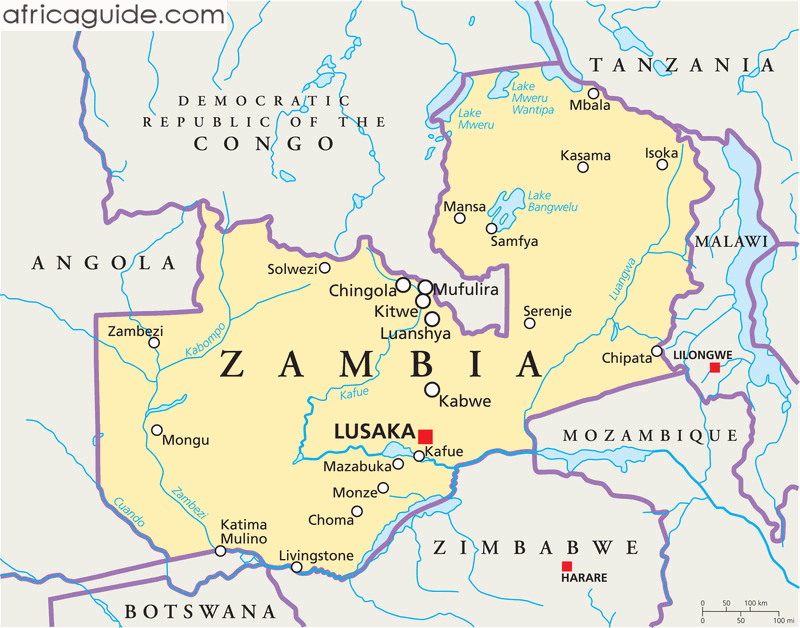
Zambia is a landlocked country located between the southern rim of the Dem Rep. Congo Basin and the Zambezi River. Zambia has land borders with Tanzania to the northeast, Malawi to the east, Mozambique and Zimbabwe to the southeast, Botswana and Namibia to the south, Angola on the west and Dem Rep. of Congo to the northwest.
Most of the landmass in Zambia is a high plateau lying between 3,500 and 4,500 feet above sea level. In the northeast, the Muchinga Mountains exceed 7,000 ft in height. Elevations under 2,000 ft are found in the valleys of the major river systems. Plateau land in the northeastern and eastern regions is broken by the low-lying Luangwa River., and in the western half by the Kafue River. Both rivers are tributaries of the upper Zambezi, the major waterway of the area. The frequent occurrence of rapids and falls prevents through navigation of the Zambezi.
There are three large natural lakes, the Banweulu, Mweru and Tanganyika all situated in the northern region. Lake Bangweulu and the swamps at its southern end cover an area of 3,800 sq miles and are drained by the Luapula River. Zambia has 26 major waterfalls, the most famous of which is the might Victoria Falls
The Copperbelt, which at one time, was responsible for most of Zambia's wealth, lies in the Western Province, bordering with Dem. Rep. of Congo.
The population of Zambia is an estimated 15.4 million (2015) comprises an amazing number of ethnic groups, speaking over 70 dialects, most of which are bantu-speaking. English is the main language.
Lusaka is the capital city of Zambia. Located in the southern part of the central plateau at approx 1,300 metres above sea level it is also the largest city in the country.
Zambia is a perfect destination for a safari holiday boasting 19 national parks, Victoria Falls - a World Heritage site. It is home to over 70 species of Mammals and 740 different bird species have been recorded.