where Africa comes to you..
Mozambique Guide
Parent page
Introduction
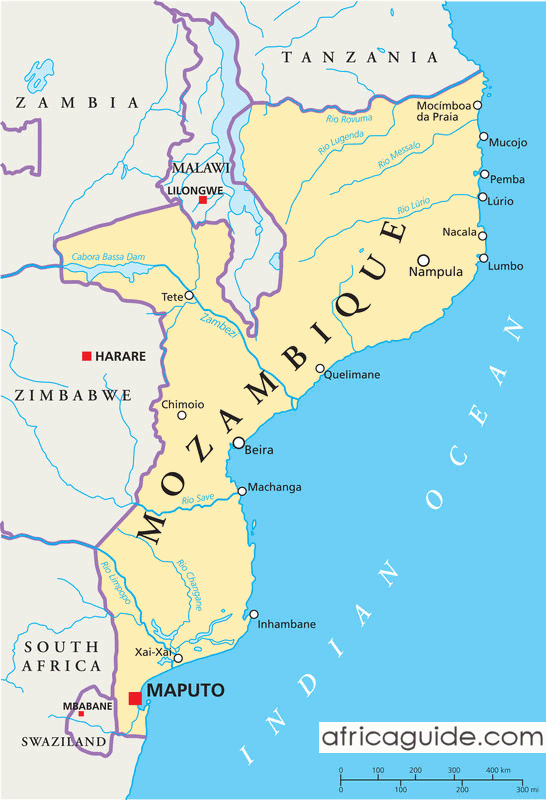
Mozambique is located on the southeastern coast of Africa and is bordered by Tanzania to the North, South Africa and Swaziland to the South, Zimbabwe to the West and Zambia and Malawi to the northwest.
Mozambique is made up mainly of coastal lowlands, rising toward the west to a plateau ranging from 500 to 2,000 ft above sea level and on the western border to a higher plateau (6,000 to 8,000 ft), with mountains in the north reaching a height of over 8,000 ft. The highest mountains are Namuli (7,936 ft), Binga (7,992 ft) on the Zimbabwean border, and Serra Zuira (7,306 ft) in Sofala Province.
The most important rivers are the Zambezi flowing southeast across the centre of Mozambique into the Indian Ocean, the Limpopo in the south, the Save in the middle and the Lugfenda in the north. The most important lake is the navigable Lake Niassa. In the river valleys and deltas, the soil is rich and fertile, but southern and central Mozambique have poor and sandy soil, and parts of the interior are dry.