where Africa comes to you..
Democratic Republic of the Congo Guide
Parent page
Introduction
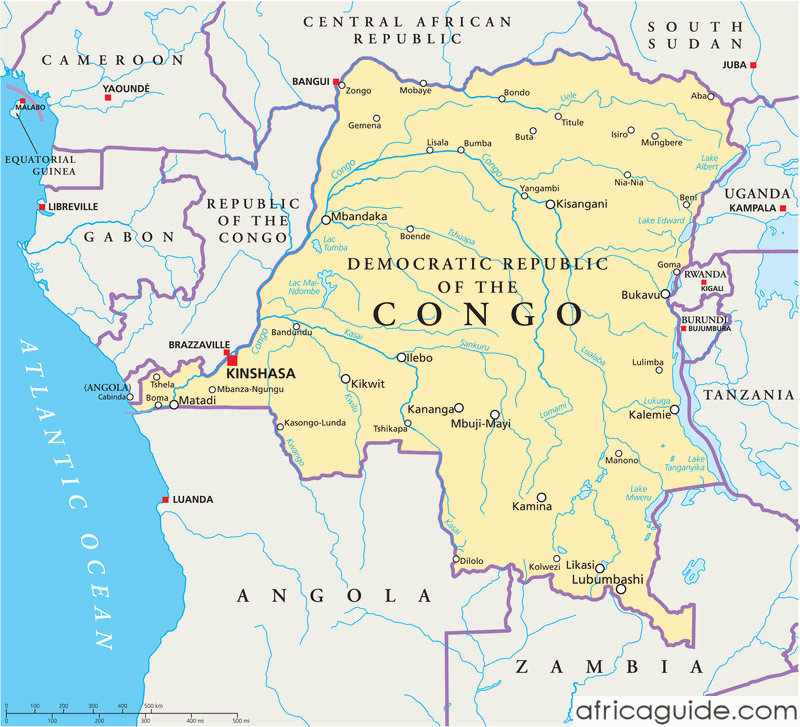
The Democratic Republic of Congo (formerly Zaire) is situated in Central Africa and it crosses the equator in the north-central region. the third largest country in Africa, it is bordered with Central African Republic to the north, Sudan to the northeast, Uganda, Rwanda, Burundi and Tanzania to the east, Zambia to the south and southeast, Angola to the southwest, and Angola and the Congo Republic to the west.
The 2,733 mile long Congo River lies mostly within the territory of the country. The enormous semicircular bend in the river delineates a central depression known as the cuvette, with an average altitude of 1,300 ft. Around this densely forested section, which covers nearly half the area of the country, a succession of plateaus rise gradually to height of over 5,000 ft in the northeast and southeast. The highest altitudes are found along the eastern fringe of the country, on the edge of the Great African Rift Valley, where dislocation of the strata has produced important volcanic and mountain masses, the most notable of which is Mt. Ruwenzori, with its peak rising to a level of 16,795 ft.
Savannah and park forest vegetation predominate north and south of the equatorial forest belt; the southern savannah belt is far more extensive than the northern one. All major rivers are tributaries of the Zaire; these include the Lomani, the Aruwimi or Ituri, the Itimburi, the Mongala, the Ugangi, the Uélé, the Kasaim the Sankuru, the Lulua, the Kwango and the Kwilu. The largest lakes include Tanganyika, Albert, Edward, Kivu, Mweru, Leopols II and Tumba.