where Africa comes to you..
Sudan Guide
Parent page
Introduction
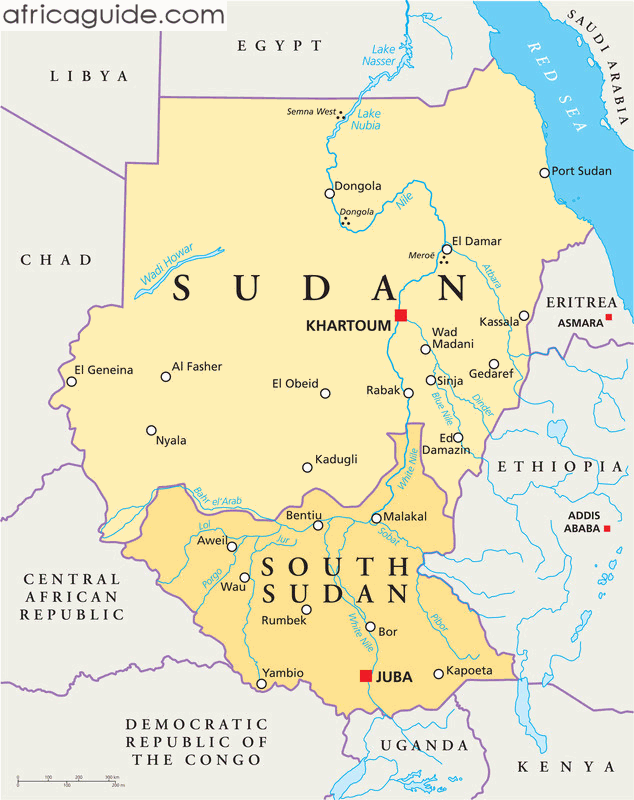
Situated in northeast Africa, the Sudan borders with Egypt to the north, Ethiopia and Eritrea to the southeast, South Sudan to the south, the Central Africa Republic and Chad to the west and Libya to the northwest.
The greatest part of Sudan is vast plain traversed by the northward flowing Nile River and its tributaries. Widely separated mountain chains and many hilly areas reach a maximum altitude of 7,000ft. The northern area is mainly desert, with rock at or near the surface covered by thin soils of low fertility. The western undulating sandy wastes merge into the Red Sea Hills to the east.
The dominating geographical feature of Sudan is the Nile River, formed near Khartoum by the confluence of the Blue Nile and White Nile Rivers. There are natural harbours at Port Sudan and Sawakin on the Red Sea. The highest elevations are in the Marra Mountains, the main mountain range.
Lowest Point: Red Sea 0m
Highest Point: Kinyeti 3,187m