where Africa comes to you..
Egypt Guide
Parent page
Introduction
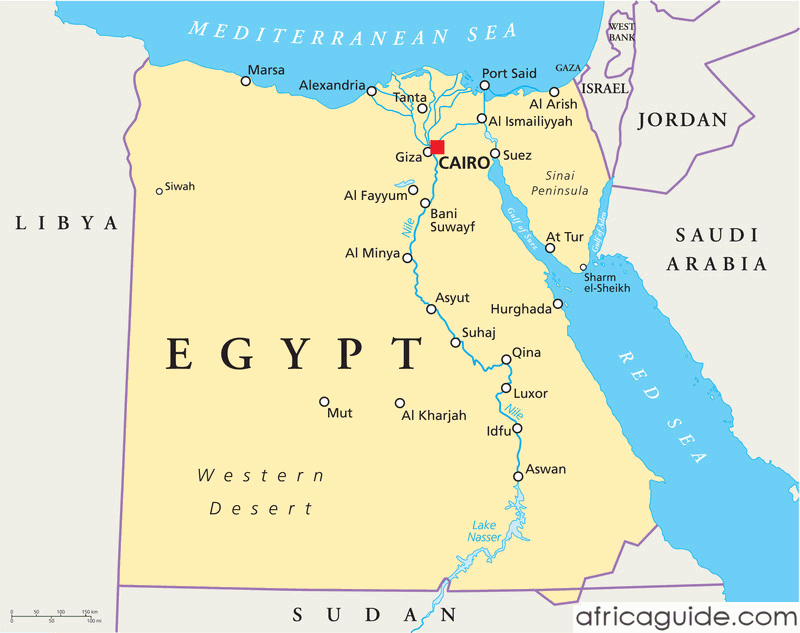
Situated at the northeastern corner of Africa, Egypt is bordered on the north by the Mediterranean Sea, in the east by Israel and the Red Sea, in the South by Sudan, and to the west by Libya.
The altitude of Egypt ranges from 132 m (436 ft) below sea level in the Libyan Desert to about 2,629 m (8,600ft) at Mount Catherine in the Sinai Pennisula. The Nile delta is a broad alluvial land, sloping to the sea for 100 miles, with a 155 mile maritime front between Alexandria and Port Sa'id. South of Cairo, most of the country (known as Upper Egypt) is a tableland rising to some 457m (1,500 ft), and the narrow valley of the Nile is enclosed by cliffs as high as 548m (1,800 ft). A series of cascades and rapids at Aswan, known as the First Cataract, forms a barrier to movement upstream.
The bulk of the country is covered by the Sahara, which north of Aswan is usually called the Libyan Desert, East of the Nile, the Arabian Desert extends to the Red Sea. The Western Desert consists of low-lying sand dunes and many depressions. The outstanding geographical feature is the Nile River, on which human existence depends, for its annual floods provide the water necessary for agricultur