where Africa comes to you..
Central African Republic Guide
Parent page
Introduction
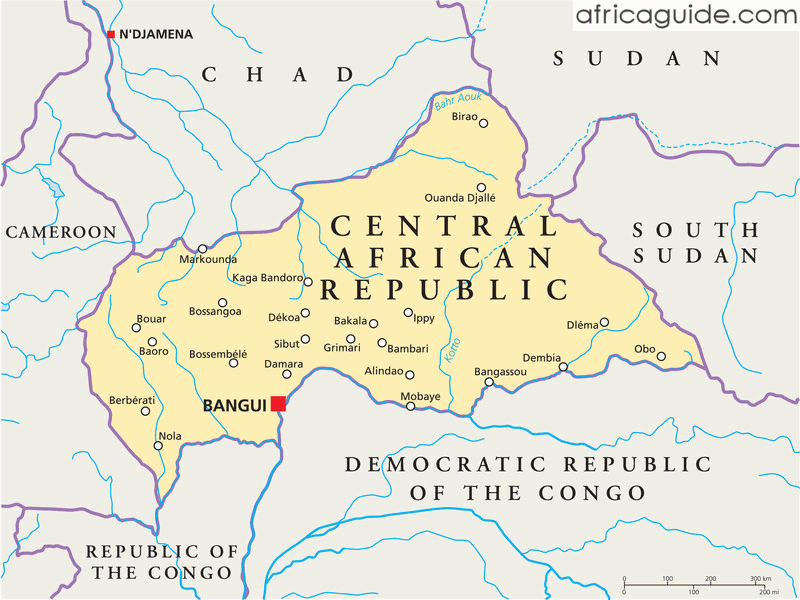
As the name dictates, the Central African Republic lies in Central Africa entirely within the tropical zone. Completely landlocked, it is bordered to the North by Chad, on the east by Sudan, on the south by Zaire and the Congo, and on the west by Cameroon. The southern border follows the bed of the Ubangi River; the eastern border coincides with the divide between the watersheds of the Nile and the Zaire rivers.
The land consists of an undulating plateau varying in altitude from 2,000 to 2,500 ft. Two important escarpments are evident: In the northwest the Yade Massif, rising to 3,750 ft, is a high granite plateau related to the Adamawa Plateau of Cameroon; and in the northeast the Fertit Hills rise to 4,200 ft and extend into the Sudan. Soils are complex: sands and clays predominate, sometimes covered with a lateritic layer, over granite and quartz rocks. The land is well drained by two river systems: the Ugangi and its tributaries in the southern and the tributaries of the Shari and Longone rivers in the north. The two largest rivers are the Ubangi (1,300 km) and the Sangha (1,400km), both tributaries of the Zaire River.