where Africa comes to you..
Cameroon Guide
Parent page
Introduction
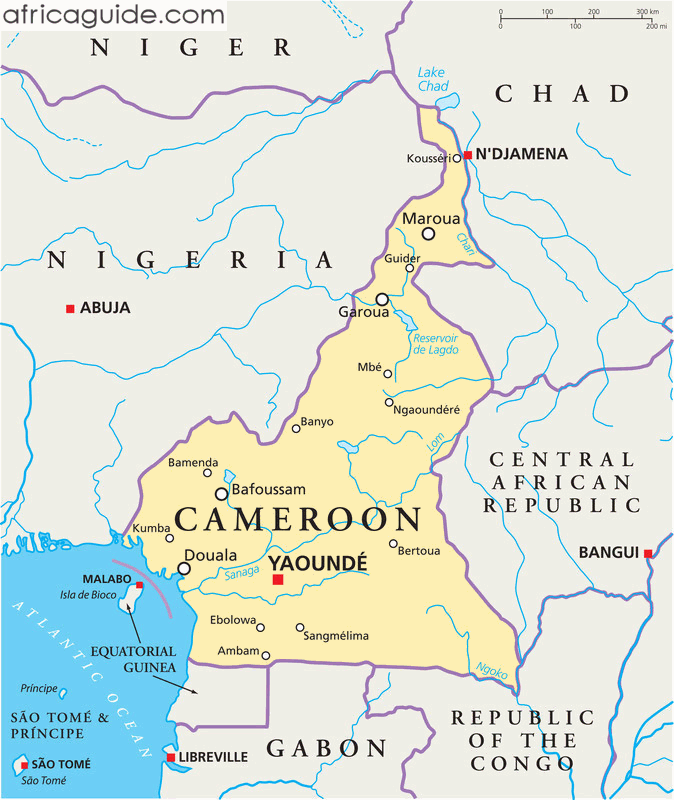
Situated in West Africa, Cameroon is shaped like an elongated triangle. It borders with Chad in the north and northeast, Central African Republic in the east, Congo, Gabon and Equatorial Guinea in the south, the Gulf of Guinea (Atlantic Ocean) in the Southwest, and to the west and northwest lies Nigeria.
There are four geographical regions. The southern region extends from the 226 mile coastline eastward to the Middle Congo Basin between the southern frontier and the Sanaga River. It consists of coastal plains of an average width of 27 miles and a densely forested plateau at an average elevation of 960 feet. The central region extends from the Sanaga River northward to the Benue River and includes the Adamawa Plateau, at elevations of 2,500 ft to 4,500 ft. This is a transitional area where forest gives way to savanna. The northern region is essentially a vast savanna plain that slopes down to the Chad basin. The west is dominated by forested mountains with peaks reaching above 8,000 ft. Of the two main rivers, the Benue is navigable several months during the year, and the Sanaga is not navigable.