where Africa comes to you..
Elephant observation
Parent page
Written by Neil, a professional safari guide in South Africa
I thought you may be interested in reading my account of some elephant behaviour I witnessed on Wednesday 2nd April at Shimangwaneni dam.
My guests and I spent an hour watching approx. 80 elephants splashing and playing in the dam - It was raining, a cloud burst while the sun was out, which made for a spectacular scene - eighty elephants in and about the dam, the rain and a beautiful rainbow as backdrop.
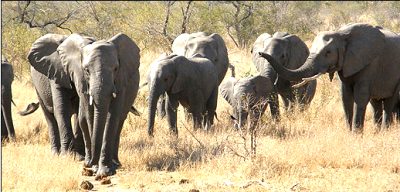
ElephantsOnce the elephants had left the dam I drove to Muzandenzi for a pit stop and then headed back towards Shimangwaneni dam. About 100 metres before the dam (on the right hand side of the road) a couple of family groups of elephants (approx. 15) were still milling around feeding. There were a few adult cows with their youngsters, and quite a few sub-adults, so if you looked at the group as a whole, you would have noticed more youngsters than older cows…
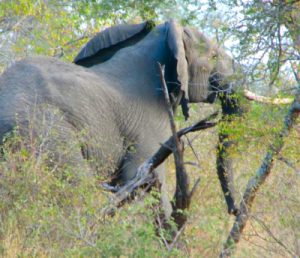
There was also a big bull hanging around - I immediately checked to see if I could see any obvious signs of musth but the recent "washing in the dam" had got rid of any telltale signs, however, I assumed he was in musth because of his demeanor which was majestic to say the least, his stance combined with the fact that he wasn't feeding led to my assumption.
The bull walked towards a huge marula tree (approx. 20-30 feet in height) with a glorious round crown and in full leaf. He took one look at the tree, and then two pushes with his forehead felled the entire tree. The sound and sight of that tree falling will stay with me for a long time but what happened next is one of the reasons for this account.
After the tree had fallen the bull walked about 20 metres away from the tree and turned towards the other elephants almost as if he was calling them. They all ran over to the felled tree and began feeding off it. 15 elephants not tall enough to reach the leaves and branches while the tree was standing were all feeding off it on the ground - like cows at a feeding trough!
One of my guest exclaimed "He has provided food for the others! He is looking after his family." This gave me an opportunity to try and guide through the social and grouping structures of elephants. I firstly explained that he wasn't an immediate part of the family grouping (no dad's at home) and that his presence in the family groups was more than likely as a result of his musth combined with the one or more of the adult females around - he was there to find a receptive female to mate with..
ElephantSometimes I allow myself a little anthropomorphic interpretation simply because I do not subscribe to the tendency we have to deny common traits with other species because we believe we are unique or special. So I don't suffer with anthropomorphophobia but sometimes may include very human traits in my interpretation of elephant behaviour.
I believe that the elephant bull pushed over the marula tree in order to gain favour from one of the cows, and that he may find one of the cows suddenly becomes more receptive to his mating request once he has provided "food" for her family?
Perhaps I'm going over the top a little but it really looked like that was happening from my position. Unfortunately I couldn't stay to watch the story unfold as it was getting late and I needed to move on back to Talamati.
I would certainly appreciate any input you may have regarding this observation but for now I'm sticking with the fireside tale - a horror story for marula's but very seductive around the fire when I tell my guests, "We're not that different from mammals when it comes to 'sexual selection' and some of the methods employed by the males to get the ladies interested!